Constantine
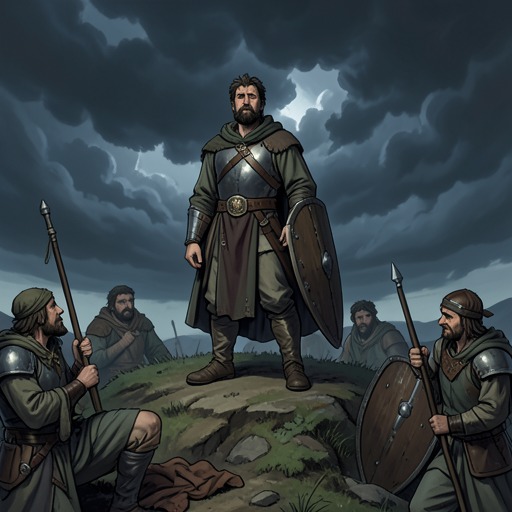
Le Morte d'ArthurConstantine, son of Sir Cador of Cornwall, is chosen king of England after Arthur’s death. His brief appearance at the close of Le Morte Darthur places him at the hinge between Arthur’s vanished fellowship and the kingdom’s next reign: he is praised as a noble knight and an honorable ruler, but cannot keep the surviving Round Table knights at his court.
Identity and place in the succession
Constantine is identified as Sir Cador’s son, and the closing account gives him the throne after Arthur. Earlier, as Arthur prepared for the Roman campaign, Cador was assigned to escort the Roman ambassadors out of Britain, establishing Constantine’s father as a figure in the king’s service. The narrative does not develop Constantine’s own actions during Arthur’s reign; his importance is concentrated in the succession that follows the final losses.
The end of Arthur’s reign
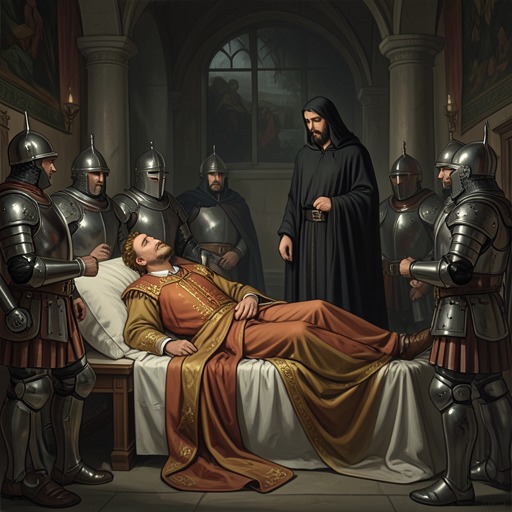
The succession takes place after Sir Launcelot’s death. Launcelot’s companions keep his body on a bier for fifteen days and then bury him with great devotion. They remain with the Bishop of Canterbury at his hermitage for more than a month. Only after this period of mourning is Constantine chosen king, so the change of ruler follows not a triumphant restoration but the burial and withdrawal of the fellowship’s last great figure.
Rule and the dispersal of the knights
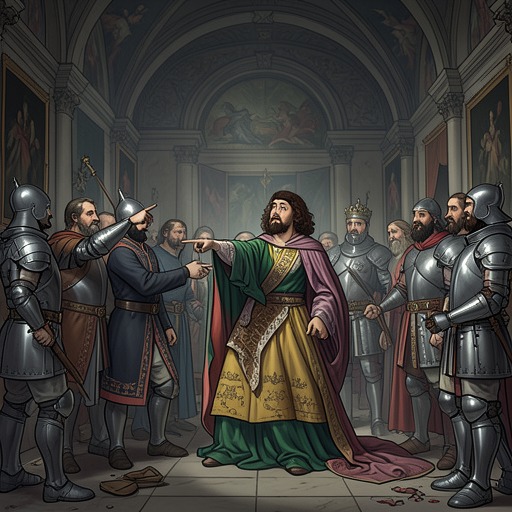
The account calls Constantine a noble knight who rules the realm honorably. He sends for the Bishop of Canterbury, learns where he has withdrawn, and restores him to his bishopric; the bishop then leaves the hermitage. Bedivere, by contrast, remains a hermit for the rest of his life. Constantine also seeks to retain the surviving knights at court, but they refuse to stay and return to their own countries, where they live as holy men.
Narrative significance
Constantine’s accession supplies a political ending, but not a return to the world that Arthur’s court once embodied. The crown passes to a new king, while the knights who might have sustained its old fellowship depart. The closing narrative thus distinguishes the continuity of rule from the dissolution of the Round Table: Constantine can govern honorably, yet the community formed around Arthur does not reassemble under him.